

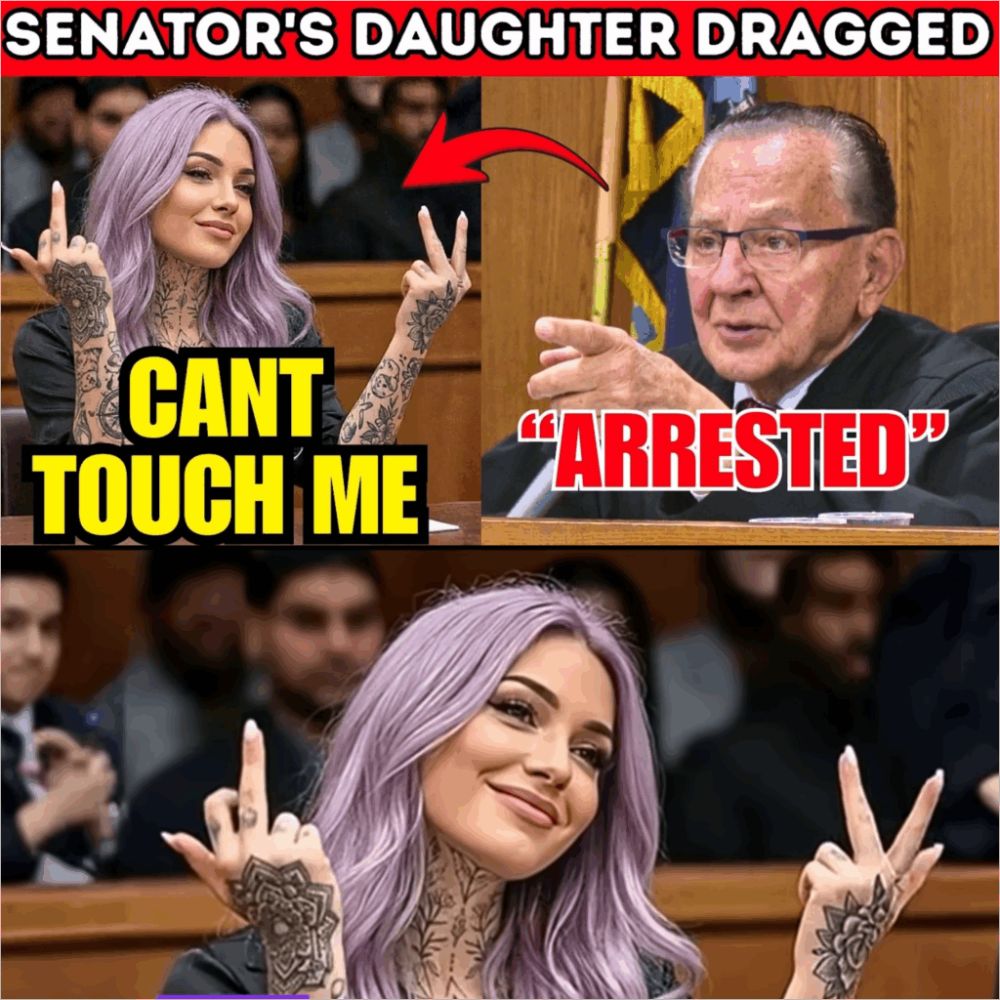
Senator’s Daughter Says ‘You Can’t Touch Me’ –Dragged Out in Handcuffs 15 Minutes Later
The Fall of Entitlement: Victoria Romano’s Courtroom Drama
Introduction
In a striking display of privilege colliding with the law, Victoria Romano, the daughter of a sitting senator, found herself in a Providence Municipal Court facing serious charges. Her courtroom appearance, marked by arrogance and entitlement, quickly turned into a lesson on accountability as Judge Frank Caprio delivered a verdict that would shatter her expectations of immunity due to her father’s political status. This incident not only highlights the dangers of entitlement but also serves as a reminder that no one is above the law, regardless of their family connections.
The Courtroom Arrival
On a Thursday morning at 10:30 AM, Victoria Romano entered Judge Caprio’s courtroom with an air of confidence that seemed to suggest she was untouchable. Dressed in designer clothes and carrying a $4,000 Hermès bag, she strutted into the courtroom as if she owned the place. Her demeanor was dismissive, and she appeared to treat the court proceedings as a mere inconvenience in her otherwise glamorous life. Following her was Thomas Whitman, a high-profile defense attorney, whose usual confidence seemed shaken as he whispered urgent instructions that Victoria ignored.
The reason for her appearance in court was serious: last Saturday night, Victoria had been driving her father’s government vehicle through downtown Providence at high speed, running multiple red lights while livestreaming her reckless behavior. The situation escalated when she crashed into a parked police cruiser, leading to her arrest. Instead of showing remorse, Victoria’s first instinct was to leverage her father’s political status, believing it would shield her from the consequences of her actions.
The Incident That Sparked Controversy
Victoria’s reckless driving and subsequent behavior when confronted by law enforcement officers painted a vivid picture of entitlement. Upon crashing into the police cruiser, she stepped out of her vehicle and exclaimed, “Do you idiots know who my father is? You can’t touch me. I’m Senator Romano’s daughter.” This statement exemplified her belief that her father’s position granted her immunity from the law.
When Officer Martinez attempted to administer a breathalyzer test, Victoria laughed and refused, claiming, “I don’t submit to tests from people who work for my family. My father funds your paychecks.” Her refusal to comply with law enforcement and her threats to the officers showcased a troubling disconnect from the reality of her situation.
The Court Hearing
As Victoria stood before Judge Caprio, she expected her connections to make the legal troubles disappear. However, Judge Caprio had reviewed the body camera footage from the incident and was prepared to deliver a lesson in accountability. The courtroom atmosphere shifted as Victoria’s arrogance clashed with the serious nature of the proceedings.
When the judge called her name, Victoria sauntered to the defendant’s table, still exuding confidence. Ignoring the judge’s greeting, she began taking selfies in the courtroom, treating the situation as a spectacle rather than a serious legal matter. Judge Caprio’s patience was tested as he attempted to regain control of the proceedings.
The Arrogance on Display
Victoria’s casual dismissal of the court proceedings as inferior to her personal life sent shockwaves through the gallery. When she finally acknowledged Judge Caprio, she shrugged off his request to put her phone away, stating, “I have a spa appointment at noon, and they don’t reschedule for government employees.” This comment further illustrated her belief that her status afforded her special treatment.
Judge Caprio pressed on, detailing the charges against her, including driving under the influence and destruction of government property. Victoria’s explanation for her actions displayed a complete lack of accountability, as she claimed she was not drunk and had only consumed two cocktails at a charity event. Her insistence that the crash was merely an unfortunate accident did little to mitigate the gravity of her situation.
The Misunderstanding of Immunity
As the hearing progressed, Victoria’s claims of immunity became increasingly absurd. She maintained that her father’s position granted her special status, insisting that local police were powerless to arrest her. Judge Caprio calmly explained the legal realities, emphasizing that senators’ families do not possess diplomatic immunity. Victoria’s shocked expression revealed her ignorance of the law and her inability to comprehend the consequences of her actions.
When the judge read from the police report, which detailed her threats to the officers, Victoria continued to rationalize her behavior. She claimed that she was merely educating the officers about government hierarchy and that her father’s influence would ultimately resolve the situation. This delusion of grandeur only deepened her predicament.
The Moment of Reckoning
Judge Caprio’s patience wore thin as Victoria continued to assert her entitlement. He pointedly asked her to explain her statement about her father’s office contacting the Department of Justice regarding her case. Victoria, seemingly unaware of the implications of her words, confidently asserted that her father’s office would handle the matter diplomatically.
This moment marked a turning point in the proceedings. Judge Caprio’s demeanor shifted as he explained to Victoria that her father’s position did not grant her immunity from the law. He firmly stated, “No one is above the law. Not senators, not their children, not anyone.” This powerful reminder of accountability resonated throughout the courtroom.
The Sentencing
As the hearing reached its climax, Judge Caprio delivered his verdict. He outlined the serious nature of Victoria’s offenses, emphasizing the need for accountability. For driving under the influence and destroying government property, he sentenced her to ninety days in county jail, a $5,000 fine, and a two-year license suspension. The additional charges for threatening law enforcement and claiming false immunity resulted in further penalties.
Victoria’s reaction was one of disbelief. She pleaded for leniency, insisting that her actions were merely a traffic incident. However, Judge Caprio made it clear that this was not just a minor offense but a serious abuse of her political privilege.
The Consequences of Entitlement
As the bailiff approached to take Victoria into custody, she continued to protest, claiming that her father’s influence would protect her. However, Judge Caprio’s response was unwavering. He ordered the bailiff to contact the FBI’s Public Integrity Section to investigate her claims of federal obstruction of justice. Victoria’s world began to crumble as she realized that her family’s name and status could not shield her from the consequences of her actions.
Outside the courthouse, news crews captured footage of Victoria being led away in handcuffs, a stark contrast to her earlier confidence. Within hours, her father, Senator Anthony Romano, held a press conference denouncing her behavior and confirming that his office had not intervened in her case.
Conclusion
The dramatic courtroom encounter between Victoria Romano and Judge Frank Caprio serves as a powerful reminder of the dangers of entitlement and the importance of accountability. Victoria’s belief that her father’s political status would shield her from the law ultimately led to her downfall, demonstrating that no one is above the law, regardless of their connections.
As Victoria begins her sentence, she faces the harsh reality that privilege does not equate to immunity. Judge Caprio’s ruling not only punished her crimes but also reinforced the principle that justice is blind to political influence. This incident serves as a cautionary tale for those who believe that their status can protect them from the consequences of their actions, reminding us all that accountability is a cornerstone of a just society.