

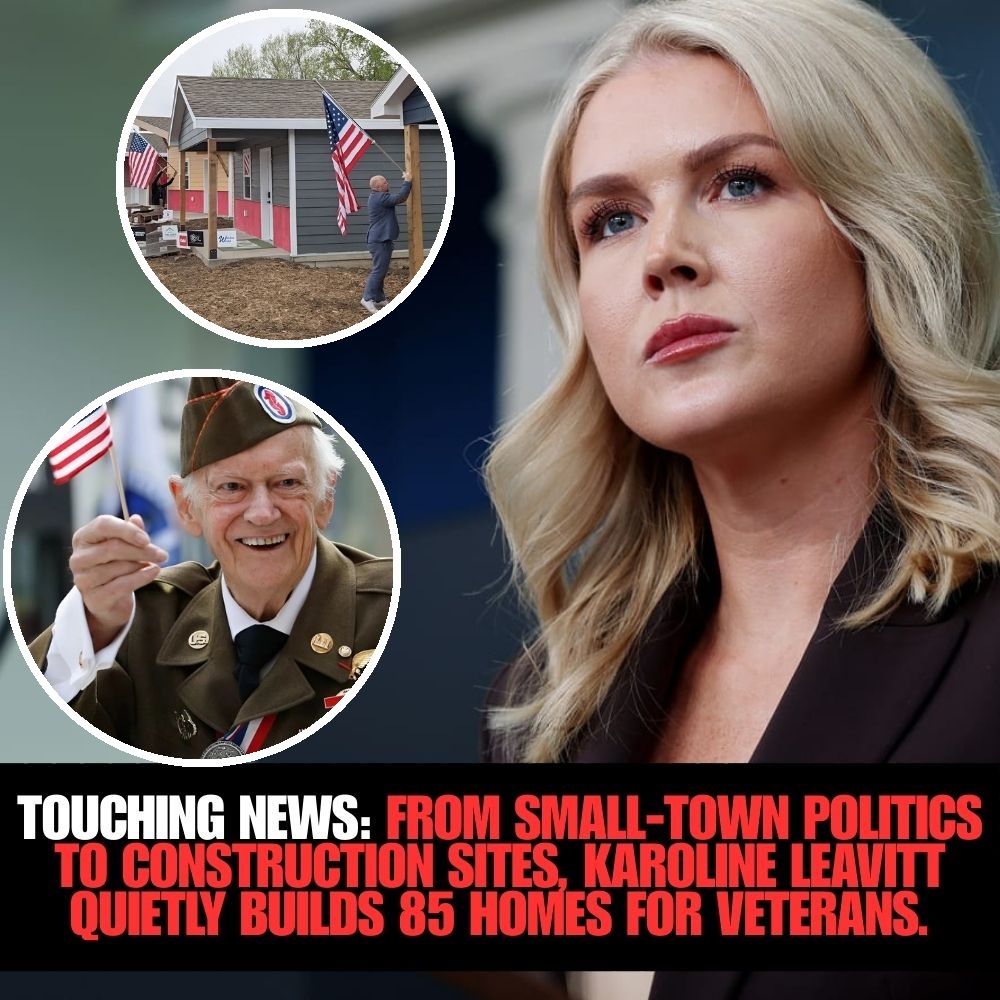
TOUCHING NEWS: From small-town politics to construction sites, Karoline Leavitt quietly builds 85 homes for veterans.
No cameras. No speeches. No headlines.
Just a hard hat, a pair of work gloves, and a purpose.
In an era where political gestures often arrive packaged for social media, perfectly framed for campaign ads or late-night talk show commentary, what happened on a chilly Thursday morning in Merrimack County, New Hampshire, was the exact opposite.
Karoline Leavitt—former congressional candidate, communications director, and one of the most polarizing young figures in conservative politics—walked onto a half-finished construction site just after dawn.
She didn’t bring press.
She didn’t alert donors.
She didn’t announce it on X, Instagram, or Facebook.
Instead, she arrived in an oversized sweatshirt, a borrowed hard hat, and a pair of worn gloves tucked under her arm.
The workers didn’t even recognize her at first.
But what she came to do would quietly grow into one of the most unexpected and touching stories in American politics this year.
Because Karoline wasn’t there to talk about helping veterans.
She was there to build homes for them.
Homes she had personally helped fund.
Homes she then insisted on helping construct with her own hands.
A total of 85 homes — not symbolic “units,” not a model house for photo-ops, but real homes for real veterans.
And she built them one brick, one beam, one shovel of concrete at a time.
A Project That No One Knew About
The initiative began, not with a press conference, but with a letter.
Six months earlier, Leavitt received a handwritten note from the wife of a Marine veteran struggling with homelessness after medical debt consumed the family’s savings. Her husband, once deployed twice to Afghanistan, had been sleeping in his truck behind a grocery store.
The letter ended with one sentence Karoline reportedly kept folded in her wallet:
“He served the country. The country forgot to serve him back.”
According to one construction supervisor who later spoke on background, that letter “changed everything.”
Karoline contacted three local nonprofit housing groups, one national veterans’ foundation, and two New Hampshire developers willing to participate at cost. What emerged was an unprecedented collaboration: a fully funded community of 85 modest, dignified homes dedicated exclusively to homeless and at-risk veterans.
But she didn’t want her name on it.
She didn’t want a plaque.
She didn’t want her donation disclosed.
She insisted contractors sign a confidentiality agreement until after the homes were completed.
“She said every headline would make it less real,” the supervisor recalled.
“She didn’t want credit. She wanted results.”
Not a Speech — A Shovel of Dirt
The first time Karoline arrived at the construction site, she was given a visitor badge and told she could watch from the designated safety zone.
She refused.
“I didn’t come here to watch,” she told the foreman.
“Give me a job.”
He handed her a shovel, expecting her to take a symbolic scoop for a photo.
She didn’t stop at one scoop.
She dug for an hour.
Workers say she refused to sit down during breaks. She helped mix concrete manually when the mixer jammed. She hammered drywall anchors until her knuckles bruised. She climbed scaffolding higher than anyone expected a public figure to climb.
“She worked harder than half the crew,” one electrician said, laughing.
“I kept thinking, ‘Are we being pranked?’ She’s a politician—at least I thought she was.”
But none of it was a stunt.
“There were no cameras,” he said.
“Not one.”
Quiet Conversations with the Men Who Served
During lunch breaks, Karoline didn’t sit with the contractors.
She sat with the veterans working on the site — men and women hired through rehabilitation programs who were rebuilding not only homes, but their own lives.
Some had PTSD.
Some had been homeless.
Some struggled with addiction.
All carried stories they rarely felt safe telling.
A former Navy corpsman named Daniel said she listened “like someone who wasn’t trying to fix, but trying to understand.”
Another veteran, Alicia, remembered Karoline staying after hours one freezing night, helping cover exposed lumber before a forecasted storm.
“She could’ve gone home,” Alicia said.
“She stayed because she didn’t want the rain to ruin the framing we did that day. You don’t fake that.”
Why She Chose Silence Instead of Publicity
In Washington, silence is rare.
Silence usually means strategy, or scandal, or carefully crafted optics.
So why did Karoline choose it?
According to people close to her, the answer is deeply personal.
Her grandfather, a Vietnam veteran, spent the last years of his life fighting both illness and loneliness. Karoline visited him constantly and witnessed firsthand the emotional fracture that many veterans experience long after war ends.
“He once told me,” Karoline confided to a friend, “‘I survived the battlefield, but I didn’t survive coming home.’”
That sentence haunted her.
So when the opportunity arose to create a community—an actual physical space—where veterans could rebuild their lives with dignity, she threw herself into it completely.
And quietly.
“I don’t ever want a veteran to feel forgotten,” she told the group coordinating the project.
“If my name gets in the way of their home, then remove it.”
The Homes Themselves
Each of the 85 homes is small, sturdy, and thoughtfully designed:
2 bedrooms
A small porch
Accessible layout
Energy-efficient heating
Soundproof walls (vital for PTSD comfort)
A communal garden
A workshop where veterans can build furniture, repair tools, or simply find peace
Veterans were invited to customize elements of their future home—from paint colors to landscaping choices—something the program’s supervisors said dramatically improved emotional engagement and mental health during the process.
This was more than housing.
It was restoration.
The Moment the Story Finally Broke
It wasn’t Karoline who revealed the project.
It was a 73-year-old veteran moving into House #14.
A local reporter asked him how he managed to get into the new community.
He replied:
“I didn’t get in. I was carried in—carried by a little lady who worked in the cold with us for months. She told us we deserved a home. I didn’t know she was famous until someone told me.”
By that afternoon, photos circulated online:
Karoline, covered in dust, holding a tape measure, laughing beside a group of veterans.
No makeup.
No podium.
No prepared remarks.
Just a hard hat, a flannel jacket, and a smile so genuine it stunned even her critics.
The Country Reacts
Within 24 hours:
Veterans groups across the nation applauded her
Commentators on both sides of the aisle expressed rare admiration
The hashtag #HomesNotHeadlines trended nationwide
Donations to veteran housing nonprofits spiked dramatically
Several politicians were publicly pressured to “do more than talk”
Even some of her staunchest political opponents admitted the project was “deeply respectable.”
One columnist wrote:
“In a political landscape drowning in noise, Karoline Leavitt chose silence — and built something louder than any speech.”
Karoline’s Only Public Statement
When reporters finally approached her outside the jobsite, expecting a speech or victory lap, she gave only one sentence:
“They served us. Now we serve them.”
Then she put her hard hat back on and went back to work.
A Victory Without Applause
In the end, these homes won’t flip a district or win an election.
They won’t trend for long.
They won’t earn millions in campaign donations.
But for 85 veterans, this was the victory they’d been waiting years—sometimes decades—to receive:
A home.
A door they can lock.
A porch where they can drink morning coffee.
A room they feel safe sleeping in.
A community built by someone who didn’t just promise change — she built it with her own hands.